Autism and Trauma
The similarities, differences, and why increased understanding and assessment can be beneficial
Awareness of both autism and the impact of trauma has grown, in recent years.
As understanding has developed, so have conversations about how these experiences can sometimes appear similar on the surface, especially in how they can affect behaviour, emotions, and daily life.
Because of this, autism and trauma are sometimes confused with one another.
However, while they may share certain characteristics, they have different underlying causes, and require different types of support. It’s important we understand these differences so there can be accurate understanding, diagnosis, and care.
To explore this properly, it is helpful to first look at what they can have in common.
Why autism and trauma can look similar
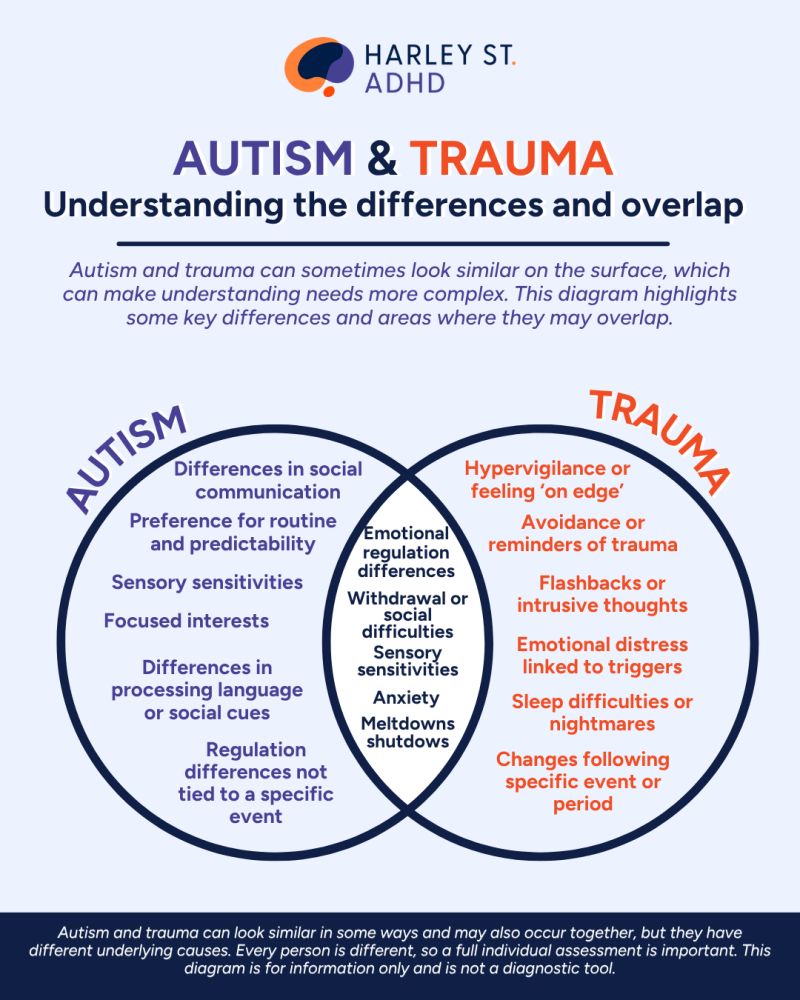
Autism and trauma can both influence how a person experiences the world, relates to others, and responds to stress. These shared features are often what lead to confusion.
Here are a few of the areas where this overlap is seen:
Social interaction and connection
Both autistic people and people who have experienced trauma can find social situations challenging.
Autistic people may experience lifelong differences in understanding social cues, communication styles, and social expectations. In trauma, social difficulties are often shaped by past experiences that affect trust, safety, and the ability to feel comfortable in relationships.
Emotional regulation
Both autism and trauma can affect how emotions are experienced and managed.
Autistic people may experience emotions strongly, especially when overwhelmed by sensory or social input. In trauma, emotional responses are often shaped by a nervous system that has learned to stay in a state of alert or threat due to past experiences.
Sensory experiences
Sensory sensitivity can be present in both autism and trauma.
In autism, sensory differences are part of how the brain processes information from early development, which can make sounds, lights, textures, or environments feel stronger or overwhelming. In trauma, the nervous system can become more reactive after distressing experiences, meaning certain sensory input may feel triggering or unsafe.
Repetitive behaviours and routines
Repetitive behaviours can appear in both autism and trauma, but for different reasons.
In autism, these behaviours are often soothing, regulating, or enjoyable and help with stability or focus. In trauma, similar behaviours may develop as coping strategies to manage anxiety, reduce distress, or create a sense of control in uncertain environments.
What are the differences between Autism and Trauma?
While there are shared features, autism and trauma differ in important ways that help distinguish between them.
How and when they begin
Autism is a neurodevelopmental difference present from early life. Trauma develops after distressing or overwhelming experiences.
How social differences show up
In autism, social differences are lifelong and consistent. In trauma, social withdrawal or difficulty often develops as a response to past experiences.
What shapes emotional responses
In autism, emotional differences are often linked to sensory processing and regulation differences. In trauma, emotional responses are shaped by the nervous system being conditioned through past threat or distress.
How sensory experiences behave
In autism, sensory differences are usually consistent across situations and present from childhood. In trauma, sensory sensitivity may fluctuate and often depends on triggers or feelings of safety.
Why repetitive behaviours happen
In autism, repetitive behaviours are often part of self regulation and identity. In trauma, they are more likely to develop as coping mechanisms for anxiety or distress.
Why understanding the differences matter and how an assessment for autism can help
Because autism and trauma can look similar, it is important to understand what is driving someone’s experiences. Misunderstanding can sometimes lead to support that does not fully meet a person’s needs.
Clear understanding helps people feel more validated, reduces confusion, and ensures they receive the right kind of support for their experience.
This is where assessment can be helpful.
An autism assessment can help bring clarity when someone is unsure whether their experiences are related to autism, trauma, or both.
It can help identify lifelong neurodevelopmental traits, separate them from trauma responses, and provide a clearer understanding of how someone experiences the world.
At Harley Street ADHD, we offer adult autism assessments that are thoughtful, supportive, and designed to help you make sense of your experiences with care and understanding. Our aim is to help you gain clarity, confidence, and access to the right support for you.